Tuesday, November 4, 2014
Blog 9: Lesson 1 Reflection
1. Positive Statement
a. What are you most proud of in your Lesson 1 Presentation and why?
I am pretty proud of my lessons in aerodynamics because I thought I did a fairly good job at explaining it in basic terms.
2. Questions to Consider
a. What assessment would you give yourself on your Lesson 1 Presentation (self-assessment)?
P
b. Explain why you deserve that grade using evidence from the Lesson 1 component contract.
I feel like I executed my lesson pretty well and met all the requirements outlined in the rubric.
3. What worked for you in your Lesson 1?
What worked for me during my first lesson was my hook activity because I told everyone to make a paper airplane... oh excuse me... a paper "glider" from a simple piece of paper. I think it was entertaining to the audience.
4. (What didn't work) If you had a time machine, what would you have done differently to improve your Lesson 1?
If i had a time machine I would practice my presentation more before hand so I knew at least a decent idea of what I was going to say and how long it was going to take.

Friday, October 31, 2014
October Additional Blog Post
This month for my senior project I have begun to work on my independent component and began the search for a new mentor.
For my independent component, I began researching different types of airfoils I could choose for the design of the craft. An airfoil is the shape of the wing from the side of it and has a huge impact on the lift and aerodynamics of the wings.(Example of the schematic of one shown below) I encountered many different varieties to choose from, all of which had different affects on the planes turning, or roll. Since I did not want to get fancy, I decided on an airfoil known as NACA(National Advisory Committee for Aerodynamics) 0015. The NACA airfoils are followed by 4 numbers. The first two decide whether or not there is any camber on the airfoil, like the one above. To make it easier and simpler on myself, I chose one without camber. Camber, by the way, is the symmetry between the top and bottom half of the airfoil. Since NACA 0015 has none, it is considered symmetrical. After second pair of numbers determines the width of the airfoil at the thickest point. Since the number is 15, that means at the max point, the airfoil is 15% of the chord length thick. (NACA 0015 Pictured below)

I decided on NACA 0015 because it was a simple one to construct and provided nothing special, but would allow the craft a fair amount of maneuverability. After deciding on this, I now must determine how long I want or need my chord length so I can begin to construct the most basic airfoil and continue from there.
For my independent component, I began researching different types of airfoils I could choose for the design of the craft. An airfoil is the shape of the wing from the side of it and has a huge impact on the lift and aerodynamics of the wings.(Example of the schematic of one shown below)
I encountered many different varieties to choose from, all of which had different affects on the planes turning, or roll. Since I did not want to get fancy, I decided on an airfoil known as NACA(National Advisory Committee for Aerodynamics) 0015. The NACA airfoils are followed by 4 numbers. The first two decide whether or not there is any camber on the airfoil, like the one above. To make it easier and simpler on myself, I chose one without camber. Camber, by the way, is the symmetry between the top and bottom half of the airfoil. Since NACA 0015 has none, it is considered symmetrical. After second pair of numbers determines the width of the airfoil at the thickest point. Since the number is 15, that means at the max point, the airfoil is 15% of the chord length thick. (NACA 0015 Pictured below)I decided on NACA 0015 because it was a simple one to construct and provided nothing special, but would allow the craft a fair amount of maneuverability. After deciding on this, I now must determine how long I want or need my chord length so I can begin to construct the most basic airfoil and continue from there.
Thursday, October 16, 2014
Blog 8: Research and Working EQ
1. What is your working EQ?
What is the best way to alter the structure of an aircraft to reduce drag and improve fuel-efficiency?
2. What is a possible answer to your working EQ?
By implementing blended wing body, an aircraft is able to produce lift across the whole structure reducing drag and weight factors allowing for improved fuel-efficiency.
What is the best way to alter the structure of an aircraft to reduce drag and improve fuel-efficiency?
2. What is a possible answer to your working EQ?
By implementing blended wing body, an aircraft is able to produce lift across the whole structure reducing drag and weight factors allowing for improved fuel-efficiency.
3. What is the most important source you have used that has helped you come up with an answer to your working EQ?
My most important source so far has been "Fundamentals of Aerodynamics" from the Naval Aviations School Command because it introduced me to several physics concepts that affect an aircraft's flight performance and allowed me to better understand why structural changes, like they blended wing body, affect the craft's fuel efficiency.
4. Who is your mentor and how does what you are doing relate to your working EQ?
I currently do not have a mentor anymore, but am looking hard to find a new one.
Wednesday, October 1, 2014
Blog 7: Independent Component 1 Approval
1. For my 30 hours, I plan to design, construct and possibly fly a remote control airplane. By doing this, I will learn the basics of aircraft design, as well as, put into practice some of the ideas and concepts I have been learning about in my research. It will also allow me to get more hands on with my project and provide me with a, hopefully, fun way to better understand my topic. Ultimately, to complete it, I will continue to research and get insight into basic aircraft design.
2. To provide proof/evidence of my 30 hours of work, I will continually take pictures as I work through all stages of the process. Along with this, I hope to have a finished project that can be presentable. If flyable, I may also produce a video with footage of it flying.
3. By designing/constructing a small scale aircraft, I am ultimately putting to practice everything I have been researching. It is a much more hands on approach that will test my knowledge on the matters and force me to learn much more. This is basically a much simplified, basic and doable aerospace engineering activity. My first interviewee also suggested that I look in to RC craft to help me learn more in depth on aerodynamics, so I am sure it will provide me with a lot of information.
2. To provide proof/evidence of my 30 hours of work, I will continually take pictures as I work through all stages of the process. Along with this, I hope to have a finished project that can be presentable. If flyable, I may also produce a video with footage of it flying.
3. By designing/constructing a small scale aircraft, I am ultimately putting to practice everything I have been researching. It is a much more hands on approach that will test my knowledge on the matters and force me to learn much more. This is basically a much simplified, basic and doable aerospace engineering activity. My first interviewee also suggested that I look in to RC craft to help me learn more in depth on aerodynamics, so I am sure it will provide me with a lot of information.
Tuesday, September 30, 2014
September Additional Blog Post
This month, I have not done too much outside work revolving around my senior topic. However, I have been extensively looking into an in-development aircraft. It is known as "Synergy" and is being designed to provide a stable aircraft, comparable to a limousine of the sky, that can achieve high speeds and great fuel efficiency. It is fast and comfortable and combines many aerodynamic and other drag-reduce proven technologies to provide substantial fuel-economy.

One of the main features this aircraft's design implements is a high span efficiency. Span efficiency is basically the distance a wing can travel vertically, before dropping horizontally. It also pertains to the aircraft's aspect ratio, which is the wingspan(b) and area of wings(s) (b^2/s). By making the wings non planar(box shape on the wings) it helps increase the span efficiency, which ultimately allows the plane to go much further and efficiently for the same wingspan as normal craft, while also being capable of higher speeds.

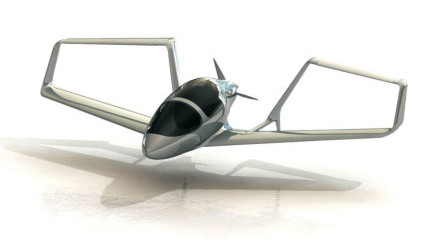
(Synergy Aircraft)

(Non planar wings shown above)
I plan to continue to research this aircraft as it gets further along in development and research. Currently, it has created a kickstarter program to raise funds to get it up in the air and create more prototypes. The ultimate end goal of this project is similar to my current proposed essential question,( What is the best way to alter the basic design of an aircraft to improve fuel-efficiency?) because they are altering the basic structure to increase the efficiency and provide comfort.
Thursday, September 18, 2014
Blog 6 - Second Interview Preparation
1. Who is your mentor and where do they work?
Frank Pina at the NASA Aero Institute in Palmdale has told me I can revisit the facility for mentorship whenever he is available, however I am going to continue to look for a more convenient and closer mentorship.
2. What five questions will you ask them about their background?
Frank Pina at the NASA Aero Institute in Palmdale has told me I can revisit the facility for mentorship whenever he is available, however I am going to continue to look for a more convenient and closer mentorship.
2. What five questions will you ask them about their background?
- Where did you attend college? Did you pursue an aerospace degree higher than the minimum 4 year bachelor-program?
- What is your official position at your workplace, and how did you come about the job offer?
- What kind of internships and aerospace work did you complete before your current position?
- What led your decision to choose aerospace engineering over the many other specialties in engineering?
- What has this company done for the aerospace engineering industry? Has it left a large impact on the industry? What is it known for?
Wednesday, September 10, 2014
Blog 5 - Mentorship Reflection
1. Mentorship question: Describe your experience in how you found your mentorship? If you haven't found one yet, describe your experience so far in the search of a mentor.
Well, I have basically found a mentor, but am still going to continue searching for one. I have not logged any hours outside of summer, however, so I have been searching. My experience in looking for one has kind of been awkward. One JPL engineer I had called and emailed talked to me up to the point where he wanted my academic resume, I sent it and never heard from him again. This kind of thing has happened a few times and is kind of frustrating, but understandable. My mom has been a big help in this because she has made so many contacts over the years. Her friend's have put me into contact with the NASA site I did my summer mentorship at and have given me a few leads as of late.
2. Research question: What has been your most important article you have read so far and why?
2. Research question: What has been your most important article you have read so far and why?
I think the most important article I read so far was one titled "Atmospheric Flight" straight from the NASA website. This article basically introduced me to the basics of airplane and airplane design. It gave me the information I needed to root my essential question in fuel conservation because it introduced me to the concepts of drag, and how it effects an aircraft. My core understanding of lift and how wings make planes flyable also came mostly from reading this article all the way through. Ultimately, it just gave the basic information I needed to understand aerospace engineering a little deeper.
Subscribe to:
Posts (Atom)