Showing posts with label Additional Blog Post. Show all posts
Showing posts with label Additional Blog Post. Show all posts
Thursday, April 30, 2015
April Blog Post
This month has been a lot of reacquainting myself with earlier research. Since we have been working on all of our findings and such for the iSearch paper, I needed to brush up on the specific details of my first answer. I also did a lot more research on some basic aerodynamics and such so I can help better understand my answers for my presentation. Besides that, not many interesting things have happened. However, I did almost find a new mentorship/summer internship at an aerospace manufacturing company. They said if I am able to go there, they will count my time there as a long interview to consider hiring me part time as I am in college. This was very exciting news and I hope it pans out, but for the moment it is on hold because my contact with them lost his brother in the midst of all this. I am not going to pressure for a response, and wait it out.

Tuesday, March 31, 2015
March Additional Blog Post
This month I came across a few interesting aircraft and spacecraft designs while researching. They do not directly relate to my EQ but they were very informative.
One of the aircraft I looked into is called Leading Edge Asynchronous Propeller Technology project (LEAPTech). Basically NASA has taken a wing and strapped 18 propellers onto it. Most aircraft only have one or two, or at the most four. By putting it on a carbon composite wing they hope to help produce more lift. Most of our current aircraft use the engines producing forward lift to in turn cause the airflow to produce lift on the wings. But with this, each of the propellers will directly blow air onto the wings to produce lift. Each individual propeller can also be adjusted to have a smooth and efficient fly experience. This technology will also allow aircraft to take off sooner because it will not need speed to get enough lift to get off and stay off the ground. Ultimately this aircraft has some strong hopes for the aircraft industry and I may look into it more for my senior project as it has some fuel-efficiency benefits. I'll definitely keep my eye on its development as it is only in the ground testing stages.

One of the aircraft I looked into is called Leading Edge Asynchronous Propeller Technology project (LEAPTech). Basically NASA has taken a wing and strapped 18 propellers onto it. Most aircraft only have one or two, or at the most four. By putting it on a carbon composite wing they hope to help produce more lift. Most of our current aircraft use the engines producing forward lift to in turn cause the airflow to produce lift on the wings. But with this, each of the propellers will directly blow air onto the wings to produce lift. Each individual propeller can also be adjusted to have a smooth and efficient fly experience. This technology will also allow aircraft to take off sooner because it will not need speed to get enough lift to get off and stay off the ground. Ultimately this aircraft has some strong hopes for the aircraft industry and I may look into it more for my senior project as it has some fuel-efficiency benefits. I'll definitely keep my eye on its development as it is only in the ground testing stages.

Saturday, January 31, 2015
January Blog Post
This month for my Senior project I have mostly been working on how I am going to complete my independent component. I have gone searching for supplies and plans, but many are not turning out to be what I need them to be. I have purchased a bunch of balsa wood in hopes that I would be able to easily form it into the airfoil to create a wing. Turns out, it is much to hard to precisely cut this with the means I have at my availability. I also have come across a great many plans that I could use, but without an expensive laser cutter to cut out parts to scale, building an airplane from a schematic is very difficult. Precision is key. As a result, I have decided to purchase a kit that comes with the parts pre-laser cut, but requires a great deal of time to precisely connect and put together. I had hoped to build it completely from scratch, but because I knew nothing of working with this before hand, I am incapable of creating it as such. Making the craft fly is also going to be difficult, but if I can get a motor and hook it up right, it should be able to get off the ground with the right airfoil structure. (When complete I plan for it to look similar to this WW2 P52 mustang like below)

Friday, October 31, 2014
October Additional Blog Post
This month for my senior project I have begun to work on my independent component and began the search for a new mentor.
For my independent component, I began researching different types of airfoils I could choose for the design of the craft. An airfoil is the shape of the wing from the side of it and has a huge impact on the lift and aerodynamics of the wings.(Example of the schematic of one shown below) I encountered many different varieties to choose from, all of which had different affects on the planes turning, or roll. Since I did not want to get fancy, I decided on an airfoil known as NACA(National Advisory Committee for Aerodynamics) 0015. The NACA airfoils are followed by 4 numbers. The first two decide whether or not there is any camber on the airfoil, like the one above. To make it easier and simpler on myself, I chose one without camber. Camber, by the way, is the symmetry between the top and bottom half of the airfoil. Since NACA 0015 has none, it is considered symmetrical. After second pair of numbers determines the width of the airfoil at the thickest point. Since the number is 15, that means at the max point, the airfoil is 15% of the chord length thick. (NACA 0015 Pictured below)

I decided on NACA 0015 because it was a simple one to construct and provided nothing special, but would allow the craft a fair amount of maneuverability. After deciding on this, I now must determine how long I want or need my chord length so I can begin to construct the most basic airfoil and continue from there.
For my independent component, I began researching different types of airfoils I could choose for the design of the craft. An airfoil is the shape of the wing from the side of it and has a huge impact on the lift and aerodynamics of the wings.(Example of the schematic of one shown below)
I encountered many different varieties to choose from, all of which had different affects on the planes turning, or roll. Since I did not want to get fancy, I decided on an airfoil known as NACA(National Advisory Committee for Aerodynamics) 0015. The NACA airfoils are followed by 4 numbers. The first two decide whether or not there is any camber on the airfoil, like the one above. To make it easier and simpler on myself, I chose one without camber. Camber, by the way, is the symmetry between the top and bottom half of the airfoil. Since NACA 0015 has none, it is considered symmetrical. After second pair of numbers determines the width of the airfoil at the thickest point. Since the number is 15, that means at the max point, the airfoil is 15% of the chord length thick. (NACA 0015 Pictured below)I decided on NACA 0015 because it was a simple one to construct and provided nothing special, but would allow the craft a fair amount of maneuverability. After deciding on this, I now must determine how long I want or need my chord length so I can begin to construct the most basic airfoil and continue from there.
Tuesday, September 30, 2014
September Additional Blog Post
This month, I have not done too much outside work revolving around my senior topic. However, I have been extensively looking into an in-development aircraft. It is known as "Synergy" and is being designed to provide a stable aircraft, comparable to a limousine of the sky, that can achieve high speeds and great fuel efficiency. It is fast and comfortable and combines many aerodynamic and other drag-reduce proven technologies to provide substantial fuel-economy.

One of the main features this aircraft's design implements is a high span efficiency. Span efficiency is basically the distance a wing can travel vertically, before dropping horizontally. It also pertains to the aircraft's aspect ratio, which is the wingspan(b) and area of wings(s) (b^2/s). By making the wings non planar(box shape on the wings) it helps increase the span efficiency, which ultimately allows the plane to go much further and efficiently for the same wingspan as normal craft, while also being capable of higher speeds.

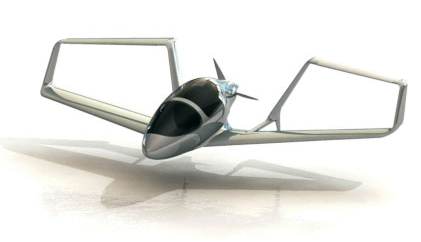
(Synergy Aircraft)

(Non planar wings shown above)
I plan to continue to research this aircraft as it gets further along in development and research. Currently, it has created a kickstarter program to raise funds to get it up in the air and create more prototypes. The ultimate end goal of this project is similar to my current proposed essential question,( What is the best way to alter the basic design of an aircraft to improve fuel-efficiency?) because they are altering the basic structure to increase the efficiency and provide comfort.
Sunday, August 31, 2014
August Additional Blog Post
During my mentorship, one of the things I got to do was work with a coding program/language known as LabView. It is a type of visual programming language that can make coding easier for some, especially when there is a lot of statements calling on previously stated things. It is basically code put into a diagram like below:


What I was asked to do with this language was more or less a repair job on a nearly completed program. One of the engineers there had begun to develop a program that would take in information from these new fiber-optic sensors that had been placed on a building model. The model appeared much like this:
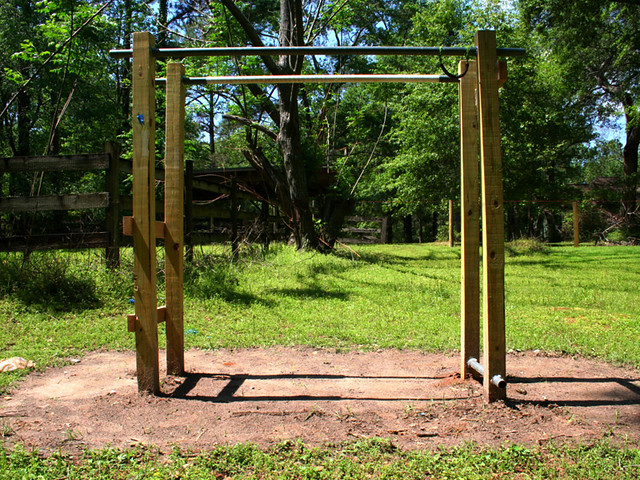
However, it was all metal and strapped with a line of sensors going down each metal bar. The end goal of the program was to display the information from the sensors into a graph. This graph would move as the structure did. This information would then be used to test the stress of the structure, but mainly was to test how effective they were at measuring the stability of certain structures. I ended up fixing the program and getting it to display the information, with help from the original engineer who had begun to develop it. I came to understand the basics of a program that most of the engineers said they use often and prefer over common coding languages. The application of these sensors was planned for many aircraft, but being first tested on stress of structures. I was exposed to that part for a good while on an experimental aircraft that was being designed to take these sensors to auto adjust a plane for the given wind conditions.
Subscribe to:
Posts (Atom)