What is the best way to decrease drag and increase fuel economy in aircraft?

Tuesday, September 30, 2014

September Additional Blog Post

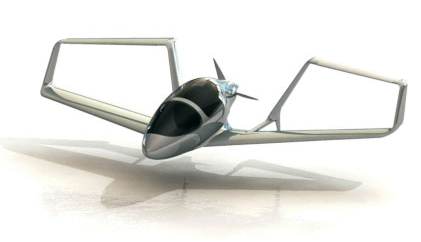
     This month, I have not done too much outside work revolving around my senior topic. However, I have been extensively looking into an in-development aircraft. It is known as "Synergy" and is being designed to provide a stable aircraft, comparable to a limousine of the sky, that can achieve high speeds and great fuel efficiency. It is fast and comfortable and combines many aerodynamic and other drag-reduce proven technologies to provide substantial fuel-economy.

(Synergy Aircraft)

     One of the main features this aircraft's design implements is a high span efficiency. Span efficiency is basically the distance a wing can travel vertically, before dropping horizontally. It also pertains to the aircraft's aspect ratio, which is the wingspan(b) and area of wings(s) (b^2/s). By making the wings non planar(box shape on the wings) it helps increase the span efficiency, which ultimately allows the plane to go much further and efficiently for the same wingspan as normal craft, while also being capable of higher speeds.

(Non planar wings shown above)

I plan to continue to research this aircraft as it gets further along in development and research. Currently, it has created a kickstarter program to raise funds to get it up in the air and create more prototypes. The ultimate end goal of this project is similar to my current proposed essential question,( What is the best way to alter the basic design of an aircraft to improve fuel-efficiency?) because they are altering the basic structure to increase the efficiency and provide comfort. 


Thursday, September 18, 2014

Blog 6 - Second Interview Preparation

1. Who is your mentor and where do they work?

     Frank Pina at the NASA Aero Institute in Palmdale has told me I can revisit the facility for mentorship whenever he is available, however I am going to continue to look for a more convenient and closer mentorship.

2. What five questions will you ask them about their background?
  • Where did you attend college? Did you pursue an aerospace degree higher than the minimum 4 year bachelor-program? 
  • What is your official position at your workplace, and how did you come about the job offer?
  • What kind of internships and aerospace work did you complete before your current position?
  • What led your decision to choose aerospace engineering over the many other specialties in engineering? 
  • What has this company done for the aerospace engineering industry? Has it left a large impact on the industry? What is it known for?

Wednesday, September 10, 2014

Blog 5 - Mentorship Reflection

1. Mentorship question: Describe your experience in how you found your mentorship? If you haven't found one yet, describe your experience so far in the search of a mentor.

     Well, I have basically found a mentor, but am still going to continue searching for one. I have not logged any hours outside of summer, however, so I have been searching. My experience in looking for one has kind of been awkward. One JPL engineer I had called and emailed talked to me up to the point where he wanted my academic resume, I sent it and never heard from him again. This kind of thing has happened a few times and is kind of frustrating, but understandable. My mom has been a big help in this because she has made so many contacts over the years. Her friend's have put me into contact with the NASA site I did my summer mentorship at and have given me a few leads as of late.

2. Research question: What has been your most important article you have read so far and why?

I think the most important article I read so far was one titled "Atmospheric Flight" straight from the NASA website. This article basically introduced me to the basics of airplane and airplane design. It gave me the information I needed to root my essential question in fuel conservation because it introduced me to the concepts of drag, and how it effects an aircraft. My core understanding of lift and how wings make planes flyable also came mostly from reading this article all the way through. Ultimately, it just gave the basic information I needed to understand aerospace engineering a little deeper.

Sunday, August 31, 2014

August Additional Blog Post

     During my mentorship, one of the things I got to do was work with a coding program/language known as LabView. It is a type of visual programming language that can make coding easier for some, especially when there is a lot of statements calling on previously stated things. It is basically code put into a diagram like below:


     What I was asked to do with this language was more or less a repair job on a nearly completed program. One of the engineers there had begun to develop a program that would take in information from these new fiber-optic sensors that had been placed on a building model. The model appeared much like this:


     However, it was all metal and strapped with a line of sensors going down each metal bar. The end goal of the program was to display the information from the sensors into a graph. This graph would move as the structure did. This information would then be used to test the stress of the structure, but mainly was to test how effective they were at measuring the stability of certain structures. I ended up fixing the program and getting it to display the information, with help from the original engineer who had begun to develop it. I came to understand the basics of a program that most of the engineers said they use often and prefer over common coding languages. The application of these sensors was planned for many aircraft, but being first tested on stress of structures. I was exposed to that part for a good while on an experimental aircraft that was being designed to take these sensors to auto adjust a plane for the given wind conditions. 

Wednesday, August 27, 2014

Blog 4: Interview Preparation

1. Who do you plan to interview? Why?

      I have been unable to schedule an interview, but I should be able to interview an Aerospace Engineer who works at JPL that I have come in contact with. However, this may not workout so I am continuing to look for another interviewee. I want to interview him because he works in JPL which works directly with rockets and space components something I think my topic will focus on more.

2. What additional questions do you plan to ask?

  • How did you choose what specific area of Aerospace Engineering you wanted to pursue?
  • What can I truly expect when and if I get into this field?
  • What have you come to enjoy and appreciate about your work?
  • What can I expect in college under this major?    


Thursday, August 21, 2014

Blog 3: Topic Choice and Working EQ

1. List Your Topic:

Aerospace Engineering


2. What is the most effective means of designing an aerodynamic aircraft? (Not sure this is exactly where I want to go, but it is a start.)


3. Working Bibliography on the right.

Monday, August 18, 2014

Blog 2: Summer Mentorship

1. Mentorship Log

2. Contact Information
Frank Pena
(661) 276-2622
francisco.pena@nasa.gov (He does not always answer his phone)

3. What questions were raised because of the 10 hours of experience?
What side of Aerospace engineering would I consider going in to?
What is the best place I can go to school for this?
Should I consider other fields of engineering?

4. What was the most important thing you gained from this experience? Why?
The most important thing I gained from this experience was the exposure to multiple different types of engineering. When I went there looking to be mentored in Aerospace engineering, I instead got to see Aerospace, Mechanical, Civil and Electrical engineers working together and specializing in different things. This was so important because it has helped me understand what engineering as a whole is and a little more about all of the possible fields I can join.

5. What is your Senior topic going to be? How did what you did help you choose a topic? Explain.
My senior topic is still going to be Aerospace engineering, space and things that fly have always amazed me and my experience helped show me why. This mentorship helped me choose my topic because it solidified my interest in aerospace engineering with first-hand experience, as well as it exposed me to other possible engineering topics and things I considered pursuing, but no longer want to after direct experience in those topics.